
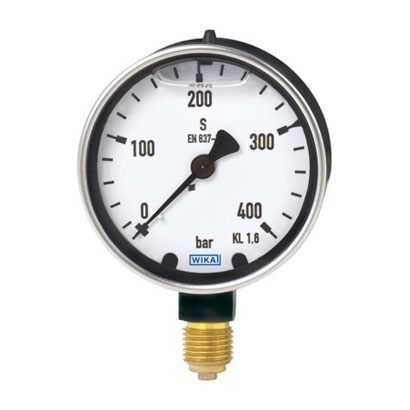
Bourdon tube pressure gauge, copper alloy
Model 213.40
Heavy-duty version, case filling, NS 63 [2 ½”], 80 [3″] and 100 [4″]
For measuring locations with high dynamic pressure loads or vibrations
For gaseous and liquid media that are not highly viscous or crystallising and will not attack copper alloy parts
Mining industry
Hydraulics
Shipbuilding
For gaseous and liquid media that are not highly viscous or crystallising and will not attack copper alloy parts
Mining industry
Hydraulics
Shipbuilding
Vibration- and shock-resistant
Especially robust design
NS 63 [2 ½”] and 100 [4″] with DNV GL approval
Scale ranges from 0 … 0.6 to 0 … 1,000 bar [0 … 10 to 0 … 15,000 psi]
Especially robust design
NS 63 [2 ½”] and 100 [4″] with DNV GL approval
Scale ranges from 0 … 0.6 to 0 … 1,000 bar [0 … 10 to 0 … 15,000 psi]
Description
The liquid-filled model 213.40 Bourdon tube pressure gauge is constructed with a forged brass case and wetted parts from copper alloy.
Scale ranges from 0 … 0.6 to 0 … 1,000 bar [0 … 10 to 0 … 15,000 psi] ensure the measuring ranges required for a wide variety of applications.
Due to the case fill fluid, the measuring element and movement are efficiently damped. Therefore, these instruments are particularly suited to measuring locations with high dynamic loads, such as fast load cycles or vibrations.
WIKA manufactures and qualifies the pressure gauge in accordance with the standards EN 837-1 and ASME B40.100. As a safety function, this instrument has a blow-out device with blow-out plug on the top of the case. In the event of a failure, overpressure can escape there.
Scale ranges from 0 … 0.6 to 0 … 1,000 bar [0 … 10 to 0 … 15,000 psi] ensure the measuring ranges required for a wide variety of applications.
Due to the case fill fluid, the measuring element and movement are efficiently damped. Therefore, these instruments are particularly suited to measuring locations with high dynamic loads, such as fast load cycles or vibrations.
WIKA manufactures and qualifies the pressure gauge in accordance with the standards EN 837-1 and ASME B40.100. As a safety function, this instrument has a blow-out device with blow-out plug on the top of the case. In the event of a failure, overpressure can escape there.